Littérature et culture numérique

Qu’est-ce qu’un modèle?

Qu’est-ce qu’un modèle?

  • Knuth (1974)
  • Meunier (2014)
  • Meunier (2017)
  • McCarty (2005), p. 20-72
  • Pierazzo (2016) pp. 37-64

L’idéologie de l’ineffable

Il y aurait des “choses” trop importantes pour pouvoir être expliquées précisément.

Un “modèle”, selon cette rhétorique, serait une “réduction”.

On imagine une réalité très complexe et ensuite une simplification de cette réalité qui serait le modèle.

Cette idéologie est ce que je voudrais questionner.

Knuth: l’informatique pour mieux comprendre

Science is knowledge which we understand so well that we can teach it to a computer; and if we don’t fully understand something, it is an art to deal with it. Since the notion of an algorithm or a computer program provides us with an extremely useful test for the depth of our knowledge about any given subject, the process of going from an art to a science means that we learn how to automate something.

Artificial intelligence has been making significant progress, yet there is a huge gap between what computers can do in the foreseeable future and what ordinary people can do. The mysterious insights that people have when speaking, listening, creating, and even when they are programming, are still beyond the reach of science; nearly everything we do is still an art.

From this standpoint it is certainly desirable to make computer programming a science, and we have indeed come a long way in the 15 years… Knuth (1974)

Russell: le rapport entre “vague” et “précis”

It is a rather curious fact in philosophy that the data which are undeniable to start with are always rather vague and ambiguous. You can, for instance, say: “There are a number of people in this room at this moment.” That is obviously in some sense undeniable. But when you come to try and define what this room is, and what it is for a person to be in a room, and how you are going to distinguish one person from another, and so forth, you find that what you have said is most fearfully vague and that you really do not know what you meant. That is a rather singular fact, that everything you are really sure of, right off is something that you do not know the meaning of, and the moment you get a precise statement you will not be sure whether it is true or false, at least right off. The process of sound philosophizing, to my mind, consists mainly in passing from those obvious, vague, ambiguous things, that we feel quite sure of, to something precise, clear, definite, which by reflection and analysis we find is involved in the vague thing that we started from, and is, so to speak, the real truth of which that vague thing is a sort of shadow. I should like, if time were longer and if I knew more than I do, to spend a whole lecture on the conception of vagueness. I think vagueness is very much more important in the theory of knowledge than you would judge it to be from the writings of most people. Everything is vague to a degree you do not realize till you have tried to make it precise, and everything precise is so remote from everything that we normally think, that you cannot for a moment suppose that is what we really mean when we say what we think.

When you pass from the vague to the precise by the method of analysis and reflection that I am speaking of, you always run a certain risk of error. If I start with the statement that there are so and so many people in this room, and then set to work to make that statement precise, I shall run a great many risks and it will be extremely likely that any precise statement I make will be something not true at all. Russell (1986) disponible ici

Le modèle comme connaissance scientifique

Modéliser signifie connaître de manière non ambigüe!

Nous ne sommes pas en train de “réduire”, mais au contraire de nous sommes en train de considérer des éléments matériels de manière rigoureuse.

Le modèle selon McCarty

By modeling I mean the heuristic process of constructing and manipulating models; a model I take to be either a representation of something for purposes of study, or a design for realizing something new. (McCarty 2005, 24)

Modéliser signifie problématiser.

computers as modeling machines, not knowledge jukeboxes

  • Simplifications de la réalité
  • Intéressants quand ils ne fonctionnent pas car ils nous montrent des aspects de la réalité non connus ou non pris en compte.

Différences entre modèle et concept:

  • le modèle est non ambigu
  • le modèle est manipulable (calculable)

La seule manière pour comprendre l’importance et les implications théoriques de la modélisation est d’essayer de modéliser quelque chose – le cas des personnifications dans les Métamorphoses.

Les trois modèles de Meunier

Meunier explique qu’il y a trois moments dans la modélisation. Les appellations de ces trois modèles ont changé dans les différentes contributions de Meunier, et nous décidons ici d’appeler le premier “modèle théorique”, le deuxième “modèle formel” et le troisième “modèle matériel”.

Le modèle théorique – que Meunier appelle aussi “modèle conceptuel” ou “représentationnel” et que Pierazzo (2015) définit simplement comme étant une “théorie” – est une description en langage naturel de ce qu’on veut modéliser. En ce qui concerne le texte, un modèle théorique sera donc une description en langue naturelle de ce que nous considérons être un texte dans une circonstance particulière. Par exemple, un chercheur pourrait décrire le texte d’une épigramme grecque comme “une série de mots organisés en quelques vers écrits par un auteur à une époque précise”, ou le texte d’un article scientifique comme “une série d’arguments organisés de façon hiérarchique dans des structures comme des sections, des sous-sections et des paragraphes et s’appuyant sur les travaux scientifiques préexistants, cités sous forme de références bibliographiques”. Il s’agit là de deux “théories du texte”, très minimalistes, certes, mais qui nous permettent d’engager une réflexion féconde. Des théories du texte bien plus générales existent évidemment – que l’on pense à l’idée de texte de Barthes (1993) ou Kristeva (1969b) –, et elles sont surtout plus ou moins explicites. À chaque fois que nous avons affaire à un texte nous sommes obligés d’en avoir une conception particulière, mais le modèle théorique peut rester très flou.

Si le sens pouvait ne pas être matériel, le modèle théorique pourrait exister seul. On pourrait s’arrêter à une “théorie du texte” qui ne s’incarne jamais dans une pratique ou dans une matérialité du texte. Mais l’idée même d’un modèle théorique comme quelque chose de séparé est une abstraction, certes utile pour la compréhension, mais qui ne correspond pas à des véritables “objets”. Le texte est toujours un objet. Le modèle théorique est lié de manière indissoluble à un modèle matériel.

Ce qui fait le pont entre le modèle théorique et la matière est le modèle formel. C’est ce modèle qui transforme la description en langage naturel en une série d’énoncés non ambigus. Meunier précise le sens de ce modèle dans le contexte numérique et c’est pour cette raison qu’il l’appelle aussi “modèle fonctionnel” ou “modèle mathématique”. C’est en effet l’aspect proprement “numérique” des approches informatiques (Vitali-Rosati 2021). Dans le cas du numérique, le modèle formel consiste à transformer la descrition théorique en des unités atomiques discrètes qui peuvent donc être comptées et structurées dans des fonctions calculables. Par exemple, dans le cas de la définition de l’épigramme, on pourra définir le mot comme unité, ensuite le vers, donner un maximum de mots par vers et un maximum de vers, ajouter l’idée de métadonnée pour renseigner le nom de l’auteur et l’époque, définir que le nom de l’auteur est un mot, etc. Ce processus peut en réalité servir au-delà du numérique. Le modèle formel est fonctionnel et mathématique dans le cadre d’un modèle “numérique” : il est justement fait de chiffres. Mais il peut être juste une explicitation formelle du modèle théorique. Dans ce cas, le modèle formel est une description avec des énoncés non ambigus du modèle théorique.

Cette énonciation non ambigüe est celle qui permet, finalement, le modèle matériel. Commençons par le cas d’un texte non numérique : une épigramme dans une édition imprimée particulière de l’Anthologie Palatine sera mise en forme pour faire en sorte que le lecteur puisse identifier son auteur, les différents vers et les mots dont ces vers sont composés. Ces concepts sont implementés dans une mise en page particulière, dans une disposition précise des caractères et des espaces, dans un usage spécifique des polices, des tailles, des approches, etc. Dans le cas d’une implémentation éléctronique, ces différents “objets” devront être représentés par des signaux éléctriques et nous aurons donc à disposition simplement deux symboles pour les représenter : le 0 et le 1. Cela implique de créer des tables de correspondance pour avoir des caractères – ASCII par exemple – et ensuite des systèmes pour représenter les autres concepts pertinents dans le modèle théorique (les mots, les vers, l’auteur, etc.).

Ce qui apparait évident dès qu’on analyse des modèles est l’interdépendance des trois étapes. Leur séparation est une abstraction utile aux fins de la compréhension, mais dans la réalité il n’y a pas de modèle théorique sans une incarnation matérielle, et cette incarnation oblige à définir un modèle formel. Le modèle théorique se précise en modèle formel lorsqu’il se confronte à la matérialité. Mais aussi, la matérialité s’impose comme le seul point de départ possible dont dérivent, après-coup, le modèle formel et finalement la théorie.

Matter matters, comme le dit Barad (2007) en soulignant l’indissociabilité entre matière et discours et donc entre matière et pensée, matière et théorie.

Les étapes de la modélisation
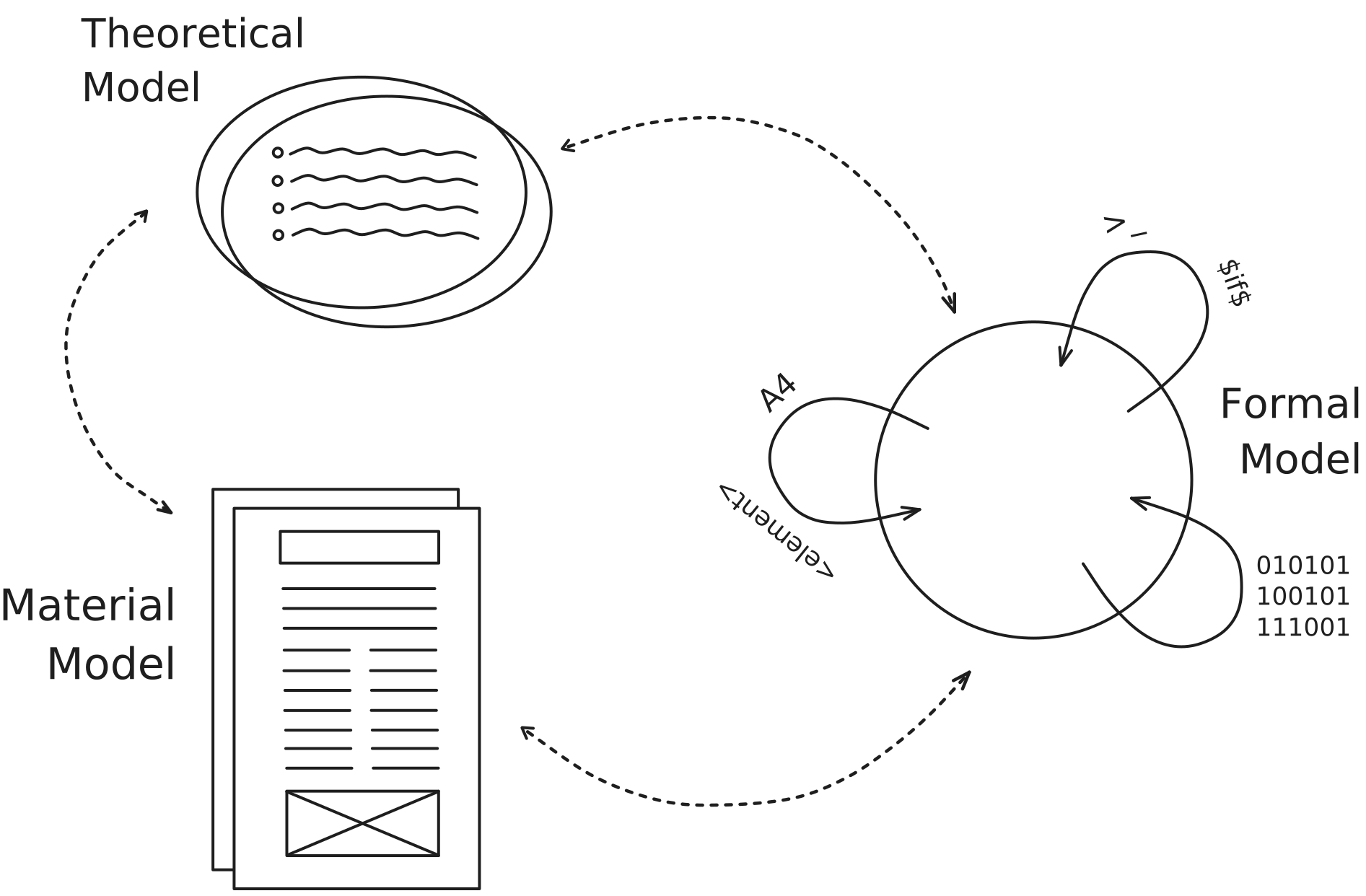
Crédits : Image réalisée par Antoine Fauchié

Les trois étapes de la modélisation ne sont séparées que théoriquement: en réalité elles constituent une unité.

Source

Le modèle de texte selon Elena Pierazzo

Un modèle de texte selon Elena Pierazzo
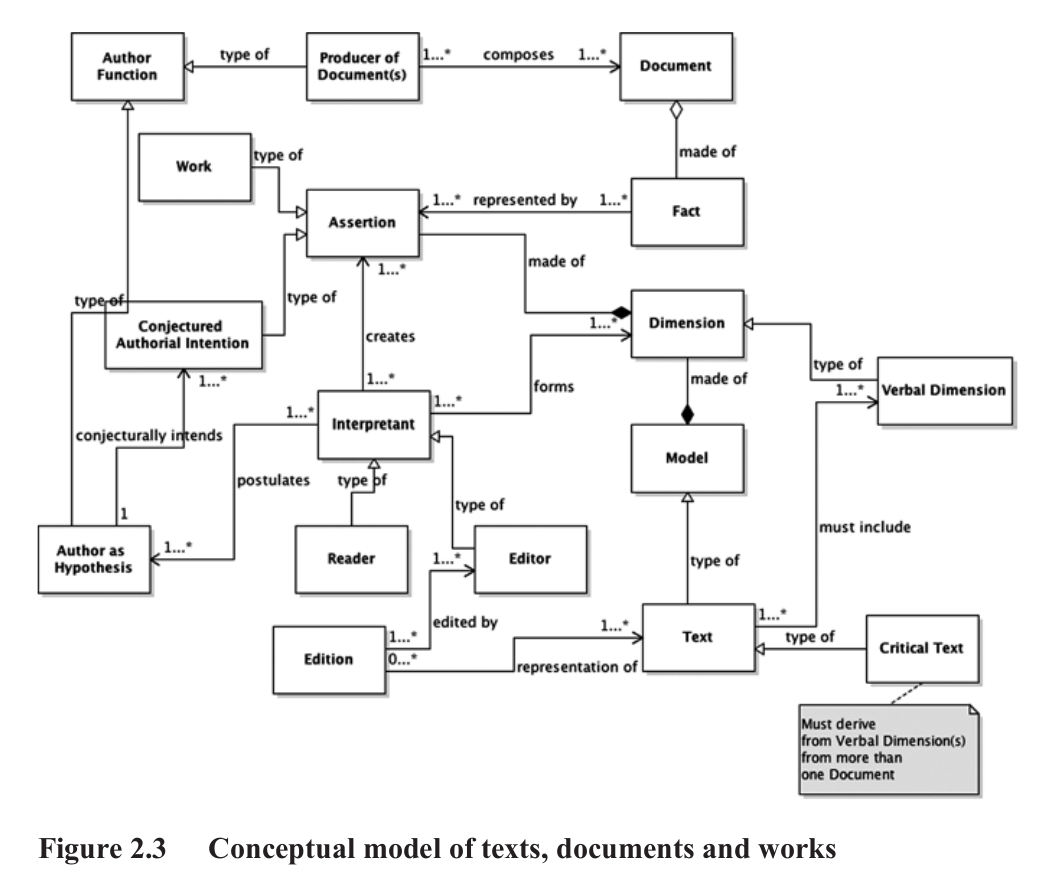
Crédits : Elena Pierazzo, Digital Scholarly Editing 2015
  • Document: l’objet physique qui a du texte (Verbal Text Bearing Object)
  • Faits: tous les faits qui concernent le document (nombre de pages, taille, matériaux…)
  • Dimensions: Modes d’interprétations des faits (par exemple “dimension paléographique”, “dimension linguistique”, “dimension sémantique”…)
  • Modèle: choix de dimension(s)
  • Texte: ce qui dérive de l’application du modèle: immatériel et interprétatif
  • Éditeur: un type d’interprétant
  • Auteur: hypothèse possible mais pas nécessaire

a text is a model that, among the facts selected by the reader, includes the verbal content of the document

Source

Matérialité et immatérialité du texte selon Elena Pierazzo
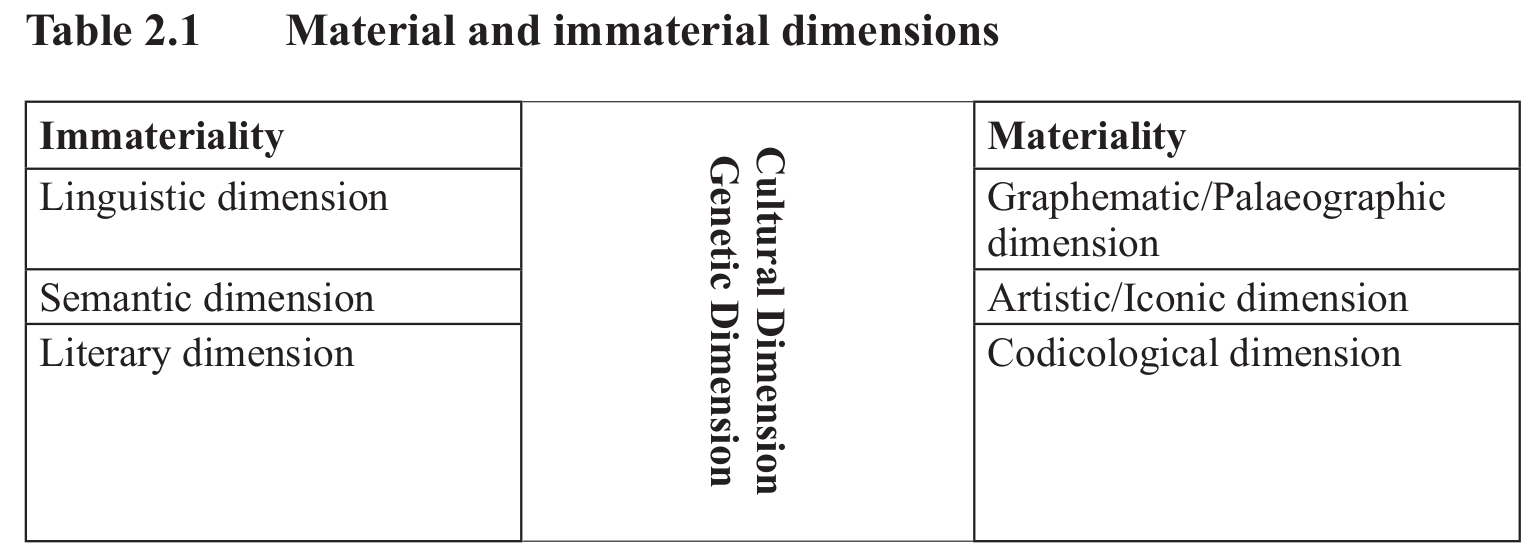
Crédits : Elena Pierazzo, Digital Scholarly Editing 2015

Of the two natures of texts – materiality and immateriality – it is the latter that allows for their transmission: texts can be transmitted (that is, transcribed and therefore made material) because they are also immaterial.p. 50

Source

Matérialité et immatérialité du texte selon Elena Pierazzo
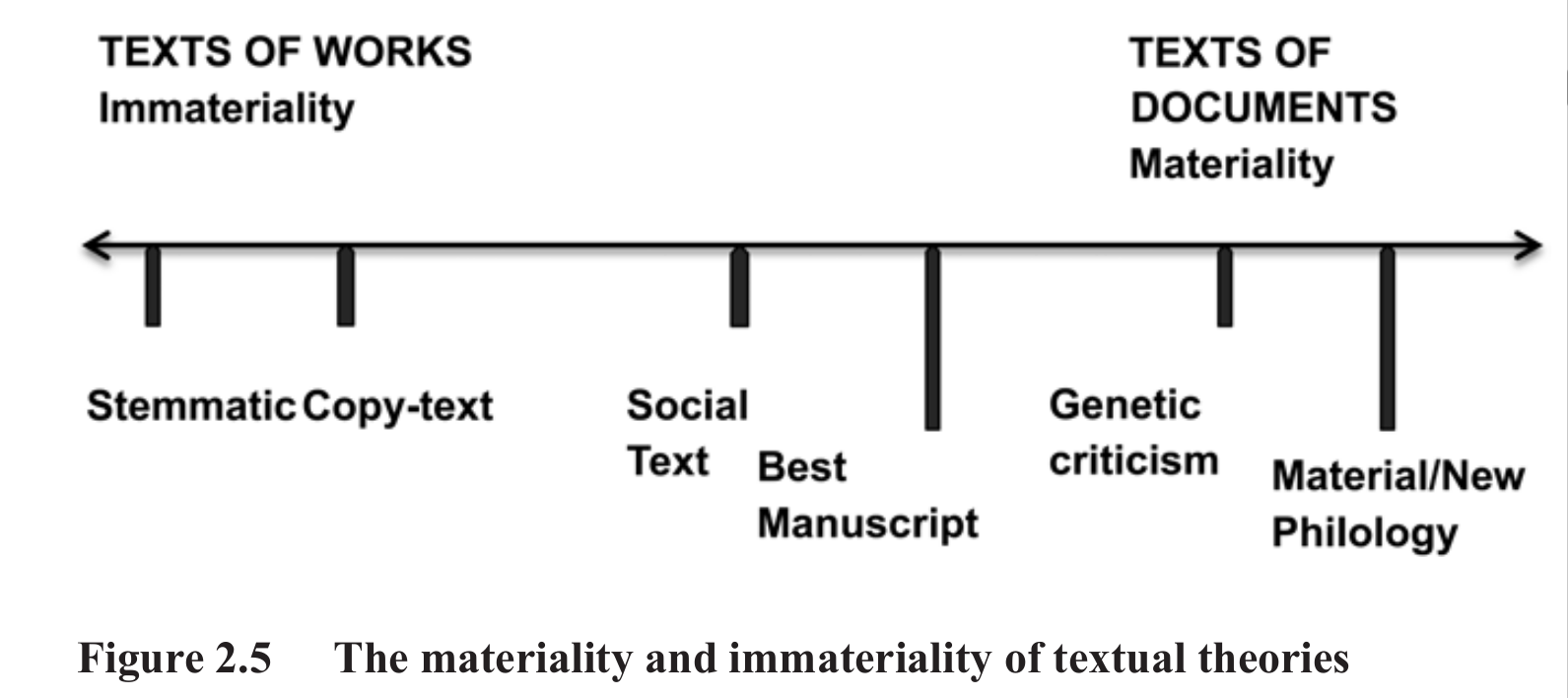
Crédits : Elena Pierazzo, Digital Scholarly Editing 2015

In this sense the work is not a physical object, but a combination of the immaterial dimensions of all the documents and all the texts that derive from them that have enough in common (‘closely related bibliographically’) to be defined as the same ‘thing’. p. 46

In fact, no edition will ever be able to account for all possible facts of a work; as Shillingsburg maintained: ‘[n]o edition is a full representation of that which it attempts to edit. No edition was ever or will ever represent a work adequately. Full stop. The positive. The hopeful. The perfection. The adequacy. The triumph of scholarship. They will not occur.’ (Shillingsburg, 2006, p. 154). p. 47-48

Source

Matérialité et immatérialité du texte selon Elena Pierazzo
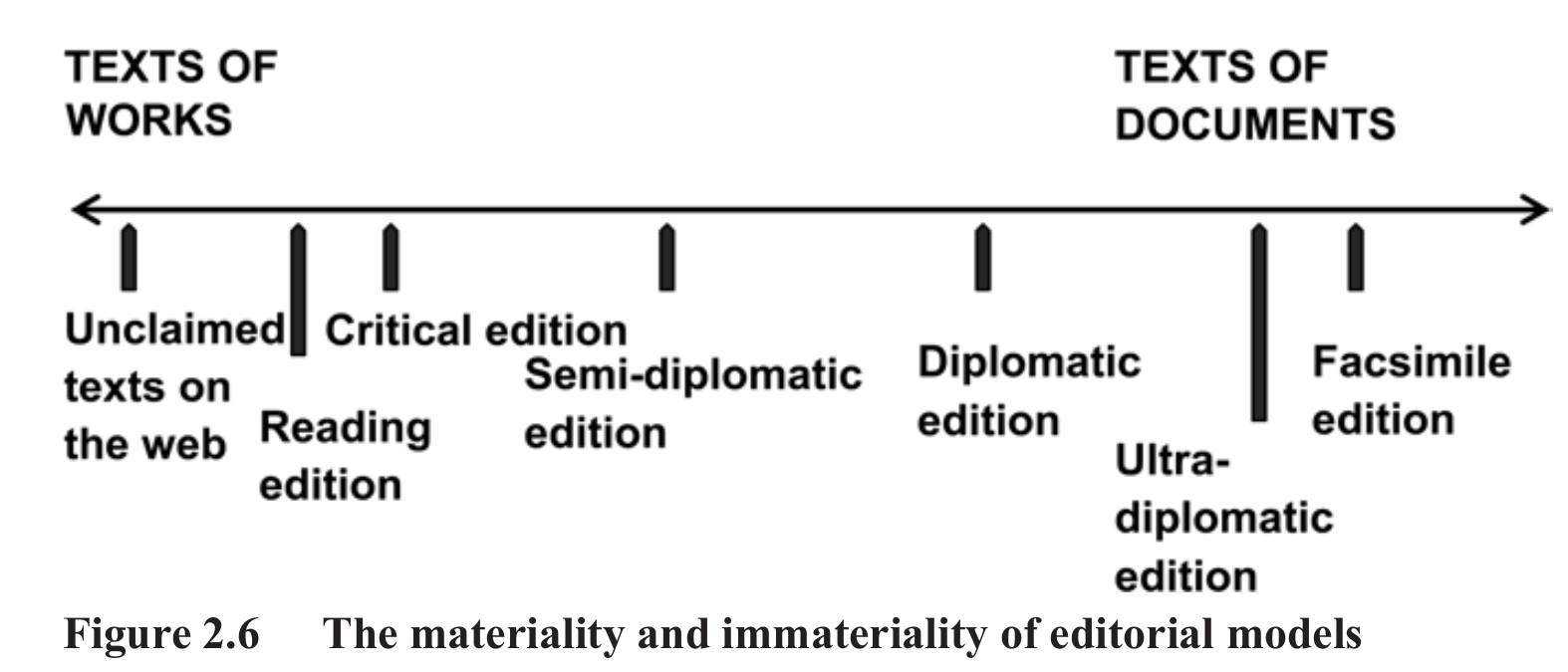
Crédits : Elena Pierazzo, Digital Scholarly Editing 2015

The maximum immateriality is offered by the category ‘Unclaimed texts on the Web’, which refers to those texts which are presented without any reference to the material editions from which they are presumably drawn: no reference to editor, source edition or original document. While presenting a very complex reality of theoretical positions in a perhaps over-simplistic way, these graphs have the advantage of showing the path between (immaterial) text and (material) document as a continuum, with no clearly defined boundaries, as well as the relative positioning and therefore distance and vicinity of different theoretical approaches. p.52.

Source

Modèle comme abstraction

S’agit-il d’une limitation du monde? Est-ce que le modèle est “partiel”? Selon cette idée – fortement “réaliste” – on aurait d’une part un réel très riche et de l’autre part un modèle du réel qui sélectionne certains aspects du réel.

Donc il y aurait:

  • un réel qui est là avant toute médiation
  • une abstraction en tant que passage de la totalité à une série particulière d’attributs observés

Et si c’était différent? Selon l’idée de Barad (2007), par exemple, la réalité n’est que le fruit des intra-actions. Le modèle est une forme de production du réel. Il n’y a pas de réel avant la modélisation.

Cela pose évidemment des problèmes de légitimité de la modélisation: quelles en sont les limites?

“Marcello Vitali-Rosati – The materiality of text : a footnote to Elena Pierazzo’s work on textual models — Montréal – colloque CRIHN”

Crédits : “CRIHN”

Source

Proposé par auteur le

Références
A catalog of digital scholarly editions. 2020. https://www.digitale-edition.de.
Alessi, Robert. 2020a. Ekdosis – typesetting TEI xml compliant critical editions. Manual. https://mirrors.ctan.org/macros/luatex/latex/ekdosis/ekdosis.pdf.
Alessi, Robert. 2020b. « Ekdosis: Using LuaLaTeX for producing compliant critical editions and highlighting parallel writings. Special Issue on Collecting, Preserving, and Disseminating Endangered Cultural Heritage for New Understandings through Multilingual Approaches ». Journal of Data Mining & Digital Humanities. https://hal.archives-ouvertes.fr/hal-02779803.
Alessi, Robert. 2021. The ekdosis package. Typesetting TEI-xml compliant Critical Editions. https://ctan.org/pkg/ekdosis.
Alessi, Robert, et Marcello Vitali-Rosati, éd. 2023a. Éditions critiques numériques: entre tradition et changement de paradigme. Parcours numériques. Presses de l’Université de Montréal. http://parcoursnumeriques-pum.ca/12-editionscritiques/.
Alessi, Robert, et Marcello Vitali-Rosati, éd. 2023b. Les éditions critiques numériques : entre tradition et changement de paradigme. Parcours Numériques 12. Les Presses de l’Université de Montréal. http://www.parcoursnumeriques-pum.ca/12-editionscritiques/index.html.
Almas, Bridget, Thibault Clérice, Hugh Cayless, et al. 2021. « Distributed Text Services (DTS): a Community-built API to Publish and Consume Text Collections as Linked Data ». mars. https://hal.archives-ouvertes.fr/hal-03183886.
André, Jacques. 1972. Règles et recommandations pour les éditions critiques, Série latine. Les Belles lettres.
Apollon, Daniel, et Claire Belisle. 2014. « The digital fate of the critical apparatus ». Digital Critical Editions, 81‑113.
Archibald, Samuel. 2009. Le texte et la technique : La lecture à l’heure des médias numériques. Le Quartanier.
Bachimont, Bruno. 2007. « Nouvelles tendances applicatives : de l’indexation à l’éditorialisation ». In L’indexation multimédia, Lavoisier. Patrick Gros.
Barad, Karen. 2007. Meeting the Universe Halfway: Quantum Physics & the Entanglement of Matter & Meaning. Duke Univ Press. https://www.dukeupress.edu/meeting-the-universe-halfway.
Barthes, Roland. 1993. Le bruissement de la langue. Seuil.
Bédier, Joseph, éd. 1976. La philologie médiévale et la critique textuelle. Les Presses de l’Université Laval.
Belouin, Pascal, Shih-Pei Chen, et Sean Wang. s. d. Designing an API-Based Protocol for the Interoperability of Textual Resources.
Bender, Emily M., Timnit Gebru, Angelina McMillan-Major, et Shmargaret Shmitchell. 2021. « On the Dangers of Stochastic Parrots: Can Language Models Be Too Big? 🦜 ». Proceedings of the 2021 ACM Conference on Fairness, Accountability, and Transparency (New York, NY, USA), FAccT ’21, mars, 610‑23. https://doi.org/10.1145/3442188.3445922.
Blanc, Julie, et Lucile Haute. 2018. « Digital publishing technology ». Sciences du Design 8 (2): 11‑17. https://www.cairn-int.info/journal-sciences-du-design-2018-2-page-11.htm.
Bleier, Roman, Martina Bürgermeister, Helmut W. Klug, Frederike Neuber, et Gerlinde Schneider. 2018. Scholarly Digital Editions as Interfaces. BoD – Books on Demand.
Bonfil, Robert, Guglielmo Cavallo, et Roger Chartier. 2001. Histoire de la lecture dans le monde occidental. [Ed. augm. d’une bibliogr. rev. et augm.]. Seuil.
Boulétreau, Viviane, et Benoît Habert. 2014. « Les formats ». In Pratiques de l’édition numérique, édité par Michael E. Sinatra et Marcello Vitali-Rosati. Parcours numériques. Les Presses de l’Université de Montréal. http://www.parcoursnumeriques-pum.ca/les-formats.
Breuil, Eddie. 2019. Méthodes et pratiques de l’édition critique des textes et documents modernes. Bibliothèque de littérature du 20siècle 27. Classiques Garnier. https://doi.org/10.15122/isbn.978-2-406-08639-0.
Broyles, Paul A. 2022. « Electronic Versioning and Digital Editions ». In Intermediate horizons: book history and digital humanities. History of print et digital culture. The University of Wisconsin Press.
Burghart, Marjorie. 2016. « The TEI critical apparatus toolbox: Empowering textual scholars through display, control, and comparison features ». Journal of the Text Encoding Initiative, nᵒ 10 (décembre). https://doi.org/10.4000/jtei.1520.
Burghart, Marjorie, et Malte Rehbein. 2012. « The present and future of the TEI community for manuscript encoding ». Journal of the Text Encoding Initiative, nᵒ 2 (février). https://doi.org/10.4000/jtei.372.
Burnard, Lou. 2015. Qu’est-ce que la Text Encoding Initiative? Traduit par Marjorie Burghart. OpenEdition Press.
Casemajor, Nathalie. 2015. « Digital Materialisms: Frameworks for Digital Media Studies ». Westminster Papers in Culture and Communication 10 (1): 4‑17. https://doi.org/10.16997/wpcc.209.
Caton, Paul. 2013. « On the term “text” in digital humanities ». Literary and Linguistic Computing 28 (2): 209‑20. https://doi.org/10.1093/llc/fqt001.
Cerquiglini, Bernard. 1989. Éloge de la variante: histoire critique de la philologie. Éd. du Seuil.
Chartier, Roger. 2005. Inscrire et effacer: culture écrite et littérature (XIe-XVIIIe siècle). Hautes études. Gallimard : Seuil.
Chartier, Roger. 2017. « Matérialité du texte et attentes de lecture. Concordances ou discordances ? » Lumen: Selected Proceedings from the Canadian Society for Eighteenth-Century Studies / Lumen : travaux choisis de la Société canadienne d’étude du dix-huitième siècle 36: 1‑20. https://doi.org/10.7202/1037851ar.
Cummings, James. 2019. « A world of difference: Myths and misconceptions about the TEI ». Digital Scholarship in the Humanities 34 (Supplement_1): i58‑79. https://doi.org/10.1093/llc/fqy071.
Dacos, Marin, et Pierre Mounier. 2010. L’édition électronique. La Découverte.
Damon, Cynthia. 2016. « Beyond variants: Some digital desiderata for the critical apparatus of ancient greek and latin texts ». In Digital scholarly editing: Theories and practices, édité par Matthew James Driscoll et Elena Pierazzo. Digital humanities series. Open Book Publishers. http://books.openedition.org/obp/3421.
Debouy, Estelle. 2023. ekdosis pour l’impatient. 3rd cycle. France. https://hal.science/hal-04059411.
Dehut, Julien. s. d. « En finir avec Word ! Pour une analyse des enjeux relatifs aux traitements de texte et à leur utilisation ». Billet. In L’Atelier des Savoirs. Consulté le 23 avril 2019. https://eriac.hypotheses.org/80.
DeRose, Steven J., David G. Durand, Elli Mylonas, et Allen H. Renear. 1990. « What is text, really? » Journal of Computing in Higher Education 1 (2): 3‑26. https://doi.org/10.1007/BF02941632.
Derrida, Jacques. 1967. De la Grammatologie. Collection "Critique". Édtions de Minuit.
Driscoll, Matthew James, et Elena Pierazzo, éd. 2016. Digital scholarly editing: Theories and practices. Digital humanities series 4. Open Book Publishers.
Drucker, Johanna. 2013. « Performative Materiality and Theoretical Approaches to Interface ». Digital Humanities Quarterly 007 (1).
Eggert, Paul. 2005. « Text-encoding, Theories of the Text, and the Work-Site11 The thinking in this study has been stimulated by countless conversations with my collaborators in the successive Just In Time Markup (JITM) projects at the Australian Scholarly Editions Centre, Phill Berrie (the programmer), Graham Barwell (University of Wollongong), and Chris Tiffin (University of Queensland); and by, if anything, even more conversations on editorial theory and textual computing with Peter Shillingsburg and, to a lesser extent, with Peter Robinson (both, De Montfort University, Leicester), who generously allowed me to read unpublished work of theirs. » Literary and Linguistic Computing 20 (4): 425‑35. https://doi.org/10.1093/llc/fqi050.
Eggert, Paul. 2009. Securing the past : conservation in art, architecture and literature. Cambridge, UK ; New York : Cambridge University Press. http://archive.org/details/securingpastcons0000egge.
Eisenstein, Elizabeth L. 1980. The Printing Press as an Agent of Change. 1 edition. Cambridge University Press.
Eisenstein, Elizabeth L. 2012. The Printing Revolution in Early Modern Europe. 2 edition. Cambridge University Press.
Epron, Benoît, et Marcello Vitali-Rosati. 2018. L’édition à l’ère numérique. Repères. La Découverte. https://papyrus.bib.umontreal.ca/xmlui/handle/1866/20642.
Fauchié, Antoine. 2018. « Markdown comme condition d’une norme de l’écriture numérique ». Reel-virtuel, nᵒ 6. https://hal.science/hal-05045977.
Fauchié, Antoine. 2024. « Fabriquer des éditions, éditer des fabriques : reconfiguration des processus techniques éditoriaux et nouveaux modèles épistémologiques ». Thèse de doctorat, Université de Montréal. https://these.quaternum.net/chapitre-04/.
Fauchié, Antoine, Roch Delannay, Michael Sinatra, et Marcello Vitali-Rosati. 2023. « Exploring New (Digital) Publishing Practices with Le Pressoir ». Pop! Public. Open. Participatory, nᵒ 5 (septembre). https://doi.org/10.54590/pop.2023.006.
Fauchié, Antoine, Jeanne Mathieu-Lessard, Markus Reisenleitner, et Nicolas Sauret. 2020. Journals in the digital age: penser de nouveaux modèles de publication en sciences humaines. juin. https://hcommons.org/deposits/item/hc:30203/.
Fauchié, Antoine, Margot Mellet, et Marcello Vitali-Rosati. 2023. « Pensée et collectif dans la matérialité de nos écritures ». Imaginations: Journal of Cross-Cultural Image Studies 14 (2): 19‑39. https://doi.org/1866/32290.
Firth, John Rupert. 1962. Studies in linguistic analysis. Repr. Special tome of the Philological society. Blackwell.
Froger, Dom Jacques. 1970. « La critique des textes et l’ordinateur ». Vigiliae Christianae 24 (3): 210‑17. https://doi.org/10.2307/1583073.
Gamble, Christopher N., Joshua S. Hanan, et Thomas Nail. 2019. « What is new materialism? » Angelaki 24 (6): 111‑34. https://doi.org/10.1080/0969725X.2019.1684704.
Genette, Gérard. 2002. Seuils. Points (Seuil).
Goff, Jacques Le. 2014. Héros et merveilles du Moyen Âge. Numérique Premium. https://doi.org/10.14375/NP.9782757842089.
Goldfarb, Charles F., et Yuri Rubinsky. 1990. The SGML Handbook. Clarendon Press.
Herrenschmidt, Clarisse. 2007. Les trois écritures: Langue, nombre, code. Gallimard.
History of TeX - TeX Users Group. s. d. Consulté le 25 août 2025. http://ftp.tug.org/whatis.html.
Ingold, Tim. 2013. Une brève histoire des lignes. 4ᵉ éd. Traduit par Sophie Renaut. Zones sensibles diff. les Belles lettres.
Irigoin, Jean. 1972. Règles et recommandations pour les éditions critiques. Série grecque. Les Belles Lettres.
Jeanneret, Yves, et Emmanuël Souchier. 2005. « L’énonciation éditoriale dans les écrits d’écran ». Communication & Langages 145 (1): 3‑15. https://doi.org/10.3406/colan.2005.3351.
Kirschenbaum, Matthew. 2001. « Materiality and Matter and Stuff: What Electronic Texts Are Made Of ». Electronic Book Review, octobre. https://electronicbookreview.com/essay/materiality-and-matter-and-stuff-what-electronic-texts-are-made-of/.
Knuth, Donald E. 1974. « Computer programming as an art ». Commun. ACM 17 (12): 667‑73. https://doi.org/10.1145/361604.361612.
Knuth, Donald Ervin. 1992. Literate programming. CSLI lecture notes 27. Center for the Study of Language; Information.
Kristeva, Julia. 1969a. [Séméiôtiké]. Seuil.
Kristeva, Julia. 1969b. Séméiôtiké — Recherches pour une sémanalyse. Points Essais. Seuil.
Lareau, Francis. 2024. « Lecture et analyse argumentaire de texte assistées par ordinateur (laatao): détection automatique d’argument dans les textes de haut niveau théorique ». Thèse de doctorat, Université du Québec à Montréal.
Longo, Giuseppe. 2025. L’empire numérique: de l’alphabet à l’IA. 1re édition. PUF.
Mandell, Laura. 2015. Breaking the book: Print humanities in the digital age. Wiley-Blackwell.
McCarty, Willard. 2005. Humanities Computing. Paperback edition. Palgrave Macmillan.
McGann, Jerome. 2014. A new republic of letters: Memory and scholarship in the age of digital reproduction. Harvard University Press.
McLuhan, M. 1964. Pour comprendre les médias. Traduit par Jean Paré. Éditions du Seuil. http://www.amazon.fr/Pour-comprendre-m%C3%A9dia-prolongements-technologiques/dp/202004594X.
McLuhan, Marshall. 1964. Understanding Media: The Extensions of Man. McGraw-Hill.
Mellet, Margot. 2024« . . . et les doigts d’écrire se referment sur la paume Recherche-Création sur l’épaisseur de l’écriture ». Thèse de doctorat, Université de Montréal.
Meunier, Jean-Guy. 2014. « Humanités numériques ou computationnelles : Enjeux herméneutiques ». Sens Public, décembre. http://www.sens-public.org/article1121.html.
Meunier, Jean-Guy. 2017. « Humanités numériques et modélisation scientifique ». Questions de communication, nᵒ 31 (septembre): 19‑48. https://doi.org/10.4000/questionsdecommunication.11040.
Monella, Paolo. 2018. « Why are there no comprehensively digital scholarly editions of classical texts? » In Digital Philology: New Thoughts on Old Questions, édité par Adele Cipolla. Libreriauniversitaria.it. https://iris.unipa.it/handle/10447/294132.
Mounier, Pierre. 2010. « Manifeste des Digital Humanities ». Journal des anthropologues, nᵒˢ 122-123 (décembre): 447‑52. https://doi.org/10.4000/jda.3652.
Naveed, Humza, Asad Ullah Khan, Shi Qiu, et al. 2024. A Comprehensive Overview of Large Language Models. arXiv:2307.06435. arXiv. http://arxiv.org/abs/2307.06435.
Norvig, Peter. 2017. « On Chomsky and the Two Cultures of Statistical Learning ». In Berechenbarkeit der Welt? Philosophie und Wissenschaft im Zeitalter von Big Data, édité par Wolfgang Pietsch, Jörg Wernecke, et Maximilian Ott. Springer Fachmedien. https://doi.org/10.1007/978-3-658-12153-2_3.
Perret, Arthur. 2022. « De l’héritage épistémologique de Paul Otlet à une théorie relationnelle de l’organisation des connaissances ». Thèse de doctorat, Université Bordeaux Montaigne. https://these.arthurperret.fr.
Pierazzo, Elena. 2015. « Modelling (Digital) Texts ». In Digital Scholarly Editing. Routledge.
Pierazzo, Elena. 2016. Digital Scholarly Editing: Theories, Models and Methods. Routledge. https://doi.org/10.4324/9781315577227.
Piper, Andrew. 2018. Enumerations: Data and literary study. The University of Chicago Press.
Pochet, Bernard. 2023. Markdown & vous: L’écriture académique au format texte avec Markdown et Pandoc. ULiège Library. https://doi.org/10.25518/978-2-87019-318-1.
Rahtz, Sebastian, et Lou Burnard. 2013. « Reviewing the TEI ODD system ». ACM, 193‑96. https://doi.org/10.1145/2494266.2494321.
Raiaan, Mohaimenul Azam Khan, Saddam Hossain Mukta, Kaniz Fatema, Nur Mohammad Fahad, Sadman Sakib, et Sami Azam. 2024. « A Review on Large Language Models: Architectures, Applications, Taxonomies, Open Issues and Challenges ». IEEE Access 12. https://ieeexplore.ieee.org/stamp/stamp.jsp?tp=&arnumber=10433480&tag=1.
Rasmussen, Krista Stinne Greve. 2017. « Reading or using a digital edition? Reader roles in scholarly editions ». In Digital scholarly editing: Theories and practices, édité par Matthew James Driscoll et Elena Pierazzo. Digital humanities series. Open Book Publishers. http://books.openedition.org/obp/3406.
Reinach, Salomon. 1883. Manuel de philologie classique. Librairie Hachette et Cie.
Reynolds, L. D., et N. G. Wilson. 1991. Scribes and scholars. A Guide to the Translation of Greek and Latin Literature. 3ᵉ éd. Clarendon Press.
Robinson, Peter. 2002. « What is a critical digital edition? » Variants. The journal of the European Society for Textual Scholarship, nᵒ 1: 43‑62.
Robinson, Peter. 2003. « Where we are with electronic scholarly editions, and where we want to be ». Jahrbuch für Computerphilologie 5 (5): 126‑46. http://computerphilologie.uni-muenchen.de/jg03/robinson.html.
Robinson, Peter. 2010. « Editing without walls ». Literature Compass 7 (2): 57‑61. https://doi.org/10.1111/j.1741-4113.2009.00676.x.
Robinson, Peter. 2013. « Towards a Theory of Digital Editions ». In The Journal of the European Society for Textual Scholarship, Brill. Variants 10. Brill Rodopi. https://doi.org/10.1163/9789401209021_009.
Russell, Bertrand. 1986. The Philosophy of logical atomism: and other essays 1914-19. Édité par John Greer Slater. The collected papers of Bertrand Russell 8. G. Allen; Unwin.
Sahle, Patrick. 2016. « What is a scholarly digital edition? » In Digital scholarly editing, édité par Matthew James Driscoll et Elena Pierazzo. OpenBook Publishers.
Sauret, Nicolas. 2020. « De la revue au collectif : la conversation comme dispositif d’éditorialisation des communautés savantes en lettres et sciences ». Thèse de doctorat, Université de Montréal.
Segre, Cesare. 2015. « Lachmann et Bédier. La guerre est finie ». In Actes du 27Congrès international de linguistique et de philologie romanes, édité par Éva Buchi, Jean-Paul Chauveau, Yan Greub, et Jean-Marie Pierrel. ATILF. https://www.diacronia.ro/en/indexing/details/V2103.
Shillingsburg, Peter L. 1996. Scholarly Editing in the Computer Age: Theory and Practice. University of Michigan Press.
Simonet-Tenant, Françoise, Michel Braud, Jean-Louis Jeannelle, Philippe Lejeune, et Véronique Montémont. 2017. Dictionnaire de l’autobiographie: écritures de soi de langue française. Honoré Champion éditeur.
Sinatra, Michael E., et Marcello Vitali-Rosati, éd. 2014. Pratiques de l’édition numérique. Parcours Numériques. Presses de l’Université de Montréal. http://parcoursnumeriques-pum.ca/1-pratiques.
Souchier, Emmanuël. 1998. « L’image du texte pour une théorie de l’énonciation éditoriale ». Les cahiers de médiologie 6 (2): 137‑45. https://doi.org/10.3917/cdm.006.0137.
Sperberg-McQueen, CM. 1991. « Text in the Electronic Age: Texual Study and Textual Study and Text Encoding, with Examples from Medieval Texts ». Literary and Linguistic Computing 6 (1): 34‑46. https://doi.org/10.1093/llc/6.1.34.
The Text Encoding Initiative. s. d. Getting started with P5 ODDs. https://tei-c.org/guidelines/customization/getting-started-with-p5-odds.
Timpanaro, Sebastiano. 1981. La genesi del metodo del Lachmann. 3e éd. Biblioteca di cultura. Liviana.
Trotter, David, éd. 2015. Manuel de la philologie de l’édition. De Gruyter.
Trouvé, Alain. 2016. « Barthes et le lexique de la critique ». Carnets. Revue électronique d’études françaises de l’APEF, nᵒˢ Deuxième série - 6 (janvier). https://doi.org/10.4000/carnets.785.
Trovato, Paolo. 2014. Everything You Always Wanted to Know about Lachmann’s Method: A Non-Standard Handbook of Genealogical Textual Criticism in the Age of Post-Structuralism, ... and Copy-Text. 2nd edition. Libreriauniversitaria.it Edizioni.
Vandendorpe, Christian. 1999. Du papyrus à l’hypertexte: essai sur les mutations du texte et de la lecture. La Découverte. http://vandendorpe.org/papyrus/PapyrusenLigne.pdf.
Vaswani, Ashish, Noam Shazeer, Niki Parmar, et al. 2017. « Attention is All You Need ». NIPS’17: Proceedings of the 31st International Conference on Neural Information Processing Systems. https://arxiv.org/pdf/1706.03762.pdf.
Vitali-Rosati, Marcello. 2014. « Les revues littéraires en ligne : entre éditorialisation et réseaux d’intelligences ». Études françaises 50 (3): 83. https://doi.org/10.7202/1027191ar.
Vitali-Rosati, Marcello. 2018. On Editorialization: Structuring Space and Authority in the Digital Age. Theory on demand 26. Institute of Network Cultures. http://networkcultures.org/wp-content/uploads/2018/03/Marcello_Vitali-Rosati_OnEditorialization-complete.pdf.
Vitali-Rosati, Marcello. 2020. « Qu’est-ce que l’écriture numérique ? » CORELA HS-33 (octobre). https://doi.org/https://doi.org/10.4000/corela.11759.
Vitali-Rosati, Marcello. 2021. « Le fait numérique comme « conjonctures médiatrices » ». Communication & Langages, nᵒˢ 208-209: 155‑70. https://papyrus.bib.umontreal.ca/xmlui/handle/1866/25755.
Vitali-Rosati, Marcello. 2024. Éloge du bug. Être libre à l’époque du numérique. Zones. La Découverte. https://www.editions-zones.fr/lyber?eloge-du-bug.
Vitali-Rosati, Marcello. 2025. C’est la matière qui pense: pour une philosophie de l’édition. De code et de plomb 1. Presses universitaires de Rouen et du Havre (PURH). https://ceen.univ-rouen.fr/matiere-marcello/.
Vitali-Rosati, Marcello, Enrico Agostini-Marchese, Timothée Guicherd, et al. 2021. « L’épopée numérique de l’Anthologie grecque : entre questions épistémologiques, modèles techniques et dynamiques collaboratives ». Sens Public. https://sens-public.org/articles/1603/.
Vitali-Rosati, Marcello, Bruno Bachimont, et Pierre Gançarski. 2022. « Modèles : du monde réel au monde numérique ». Intelligibilité du numérique, janvier. http://intelligibilite-numerique.numerev.com/numeros/n-3-2022/2633-modeles-du-monde-reel-au-monde-numerique.
Vitali-Rosati, Marcello, Antoine Fauchié, Margot Mellet, et Nicolas Sauret. 2022. « Littératies et systèmes éditoriaux numériques. Présentation des expérimentations menées dans le cadre du projet Revue 2.0 ». (Montréal, Canada).
Vitali-Rosati, Marcello, et Jean-Marc Larrue. 2019. Media do not exist. Theory on Demand. Institute of Network Cultures. https://networkcultures.org/wp-content/uploads/2019/10/Media-do-not-exist.pdf.
Vitali-Rosati, Marcello, Servanne Monjour, Joana Casenave, Elsa Bouchard, et Margot Mellet. 2020. « Editorializing the Greek Anthology: The palatin manuscript as a collective imaginary ». Digital Humanities Quarterly 014 (1). http://www.digitalhumanities.org/dhq/vol/14/1/000447/000447.html.
Vitali-Rosati, Marcello, Nicolas Sauret, Antoine Fauchié, et Margot Mellet. 2020. « Écrire les SHS en environnement numérique. L’éditeur de texte Stylo ». Intelligibilité du numérique, nᵒ 1 (septembre). http://intelligibilite-numerique.numerev.com/numeros/n-1-2020/18-ecrire-les-shs-en-environnement-numerique-l-editeur-de-texte-stylo.
Wallace, Mark. 1999. The art of Don E. Knuth. https://www.salon.com/1999/09/16/knuth.
West, Martin L. 1973. Textual criticism and editorial technique. Applicable to Greek and Latin Texts. B. G. Teubner.
Wilhelm, Raymund. 2015. « L’édition de texte – entreprise à la fois linguistique et littéraire ». In Manuel de la philologie de l’édition, édité par David Trotter. De Gruyter,.
Zacklad, Manuel. 2004. Processus de documentarisation dans les Documents pour l’Action (DopA) : statut des annotations et technologies de la coopération associées (nouvelle version corrigée). octobre.
Zhao, Haiyan, Hanjie Chen, Fan Yang, et al. 2023. Explainability for Large Language Models: A Survey. arXiv:2309.01029. arXiv. http://arxiv.org/abs/2309.01029.